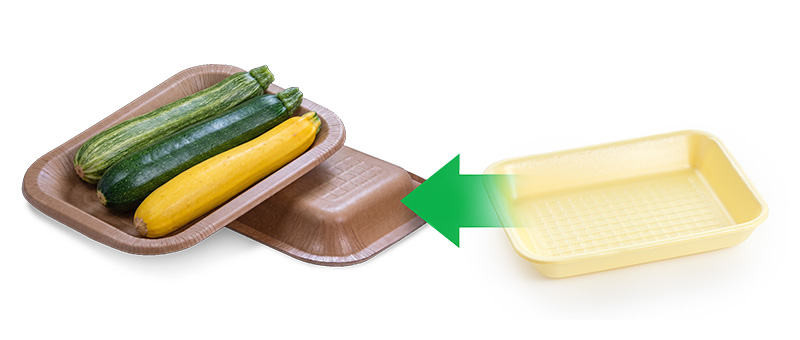
The shift away from foam and plastic packaging for fresh produce is accelerating, driven by growing regulations, retailer mandates and consumer purchasing behavior.
Here’s why produce companies are switching to moisture-resistant pressed paperboard trays:
Fresh produce market and packaging requirements are changing
Fresh produce consumption in the U.S. is on an upward trajectory:
As more fresh produce is packaged for retail, packaging itself is coming under greater scrutiny, from state legislatures to major grocery chains and today’s shoppers.
Regulations, retailers and consumers are driving the demand for recyclable produce trays
- Increasing regulations are making plastic and foam a riskier packaging choice
Fresh produce companies that rely on expanded polystyrene (EPS) foam trays are operating in a shrinking legal window. As of May 2025, 12 U.S. states, including California, Oregon, New York, New Jersey, Maryland, Maine and Vermont, have enacted EPS-related bans.Beyond EPS-specific bans, Extended Producer Responsibility (EPR) legislation is shifting the financial burden of packaging waste management from municipalities to the companies that produce it. EPR packaging laws have now been enacted in 7 states — Maine, Oregon, Colorado, California, Minnesota, Maryland and Washington — with legislation introduced or under active consideration in at least 8 additional states.For produce brands, non-compliant packaging now carries a tangible cost: compliance fees and higher disposal costs.
- Major retailers are mandating sustainable packaging
For most fresh produce companies, losing a major retailer account is a more immediate business consequence than a compliance fine. The largest grocery chains in the country have made public commitments to eliminate non-recyclable packaging:
- Walmart has flagged EPS as a material to replace with recyclable alternatives.
- Costco eliminated more than 198 tons of plastic.
- Whole Foods specifies non-EPS formats for produce packaging.
- Kroger has committed to 100% sustainable packaging by 2030.Fresh produce suppliers that cannot demonstrate compliance with retailer packaging standards risk losing critical distribution agreements.
- Consumers want more fresh produce packaged in eco-friendly packaging
For shoppers, the shelf appeal of fresh produce is increasingly influenced by whether it’s packaged and what that packaging is made of.
- 90% are more likely to purchase from a brand with eco-friendly packaging.
- 68-72% are willing to pay more for fresh produce in recyclable trays.
- 54% reported deliberately choosing products with sustainable packaging.
- 39% have switched to a competitor offering environmentally friendly packaging.
- 35% consider avoiding retailers that do not attempt to reduce non-recyclable packaging.
With consumer demand, regulatory risk and retailer mandates all pointing in the same direction, produce companies are now asking: which recyclable packaging can actually handle the processing requirement of my fresh produce?
How do moisture-resistant paperboard trays handle fresh produce?
- Moisture‑Resistance Performance
Our pressed paperboard trays feature a moisture‑resistant coating that helps prevent weakening from moisture absorption throughout the entire supply chain, from the packing line to the retail shelf. This ensures the tray maintains its shape and rigidity without warping or softening, protecting the product inside.
- High‑Speed Processing Compatibility
Our pressed paperboard trays are engineered to maintain structural rigidity and include turned‑down flanges, making them compatible with common overwrap equipment. This design helps eliminate film‑tearing concerns and allows for seamless integration into most existing production operations.
- Certifiable Sustainability
Our pressed paperboard trays are made from responsibly sourced linerboard, contain post‑consumer recycled content and are certified recyclable and repulpable by Western Michigan University. That’s what makes them ideal for brands looking to meet growing sustainability expectations from retailers and consumers.
What should you look for in a supplier of sustainable produce trays?
Not every paperboard tray is engineered to meet the demands of fresh produce, and not every supplier offers the support that produce companies require. When evaluating produce packaging suppliers, brands should look for the following:
- Domestically Sourced Paperboard from a Domestic Manufacturer
U.S. manufacturing eliminates tariff exposure and overseas freight risk. This also helps fresh produce companies secure a more reliable supply of paperboard trays, which is critical during the peak harvest window.
- Hands-On Integration Support
A supplier that offers on-site consultation and a structured integration process reduces downtime and ensures that sustainable produce packaging performs.
- Compliance Expertise
Recyclability documentation must meet major retailers’ sustainability requirements, and a supplier with regulatory fluency can help you stay ahead as state laws continue to expand.
PaperTech meets the requirements for fresh produce packaging.
With FRESHTRAYS paperboard trays, PaperTech helps fresh produce brands easily switch from foam and plastic packaging.
Operating out of a 150,000 sq. ft. facility in Ohio, PaperTech integrates structural sound, moisture-resistant paperboard trays into existing produce lines and delivers them with a 98% On-Time and Complete rate.
For more information, download our educational resource, A Guide to Sustainable Paper Trays for Fresh Produce, or visit our product page. Want to discuss how we can simplify your switch to moisture-resistant pressed paperboard trays? Talk to a specialist today.
